How My Husband's Aunty Helped Me Get My Body Back After Baby — Without Giving Up Jollof
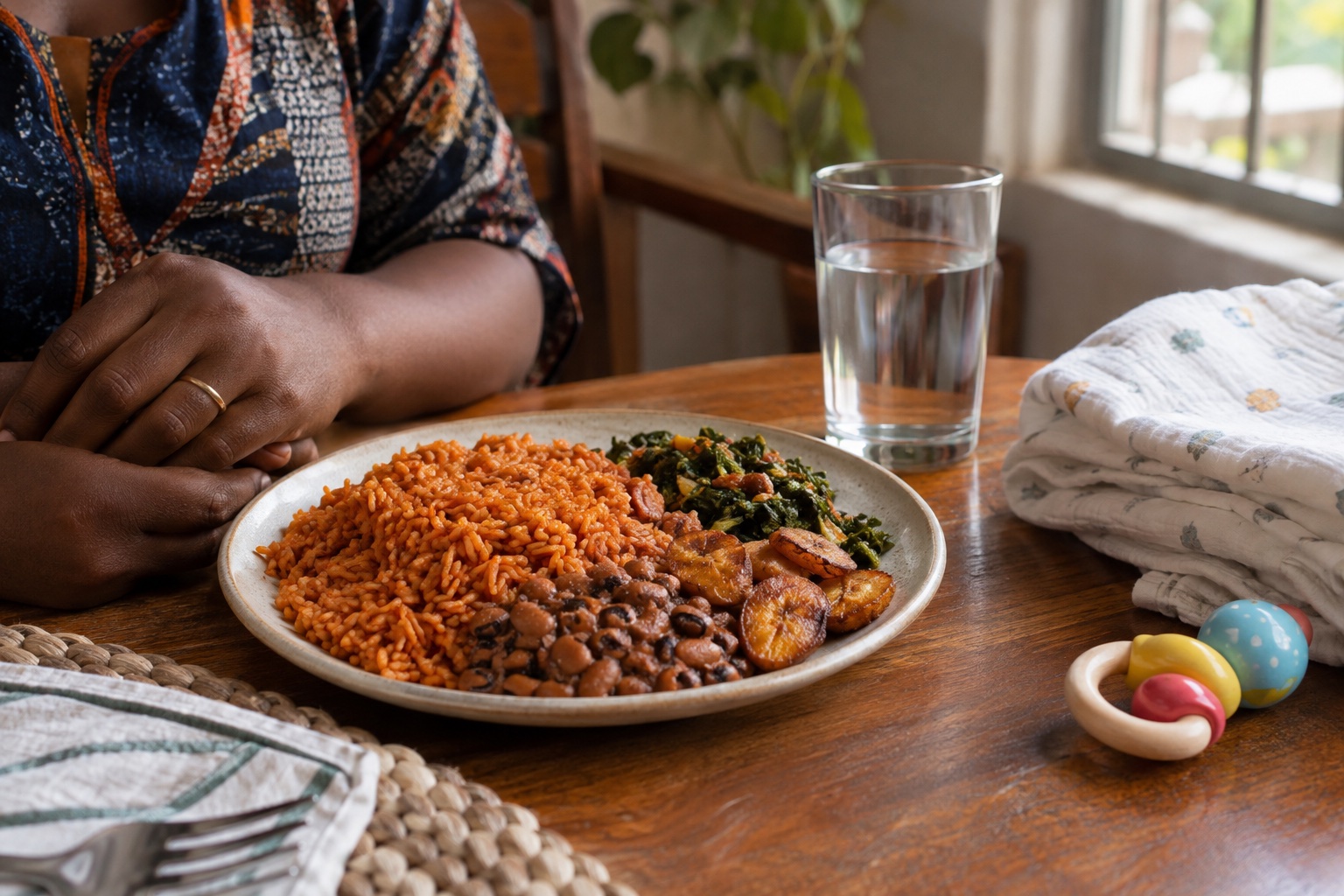
If you are secretly tired of maternity clothes that still fit eight months later, tired of the "you're still carrying baby weight?" comments at every gathering, tired of every "bounce back" plan assuming you have a free hour and a full night's sleep — read every word on this page.
You have tried. Don't let anyone tell you that you haven't tried.
You have skipped breakfast because there was no time to eat it standing up. You have downed a tea a cousin swore by, then spent a groggy morning nursing a baby anyway.
Maybe once she starts sleeping through the night, I'll finally sort myself out.
That's what you told yourself at six weeks. And at three months. And again last week.
You've stood in front of the mirror in the one dress that still buttons, turning sideways, telling yourself it's not that bad. Then you've worn the wrapper instead, again.
Here is the part nobody talks about. The real weight isn't just the number. It's what it's quietly done to everything around it.
It's the way you angle yourself away when your husband walks in while you're changing, when you used to think nothing of it. It's the family event you've already started dreading, because you know you'll spend more time arranging your outfit than actually enjoying it.
It's the photos from your pregnancy announcement that you scroll past quickly, because the woman in them looks like she's carrying something lighter than you feel right now — even though she was carrying an entire baby.
You are not lazy. You are not failing at motherhood. You are not "just not trying hard enough," no matter what that aunty at the last gathering implied.
You are simply doing the wrong thing, correctly, on almost no sleep. And nobody has told you that yet.
I know. Because I carried it too — both the baby, and everything that came after.

My name is Carol Obi.
I'm not a doctor. Not a nutritionist. I am just a new mother who spent the first year after my daughter's birth fighting my own body before anyone showed me a gentler way.
I'm from Enugu, though I've lived in Lagos since I got married. My husband, Emeka, never once complained about how I looked after having our daughter — which somehow made it worse, because I filled in the silence myself.
By month four postpartum, I had tried every "bounce back" plan a Nigerian new mother with data and a smartphone can try. A flat-tummy tea from an Instagram vendor that left me light-headed while I was still breastfeeding. An app that wanted me logging every spoon of stew with a baby crying in the next room. A "no swallow" challenge that I abandoned by day three because I simply had no reserves left to give it.
None of it held. Most of it left me more exhausted, which is the last thing a new mother recovering and feeding a baby through the night can afford.
I went to see a doctor at my six-week check. She checked my scar, checked my blood pressure, told me everything was healing "within range," and moved on to the next patient. Nobody asked how I was managing to feed a baby, run a house, and somehow also be expected to look like the "before" photo within a few months. Not one person asked me that.
The worst part wasn't the number on the scale. It was watching myself shrink in every room that had nothing to do with my body. I stopped taking pictures at family events unless someone forced me. I stopped believing Emeka when he said I looked beautiful, and I think, somewhere in there, he stopped saying it as often, because what was the point of saying something I clearly didn't believe.
Energy was spent. Money was spent. And still, every single month, I was more tired, not lighter.
My Daughter's Naming Ceremony
Three months after she was born, we held my daughter's naming ceremony in Onitsha — the kind of event where every aunty in the family shows up, the compound is full of the smell of jollof and nkwobi, and everybody is watching everybody, whether they admit it or not.
I wore a dress I'd bought two sizes up "for now," and I spent most of the morning finding reasons to stand behind other people in photographs, holding my own baby like a shield.
My husband's aunty — the one everybody calls Aunty Ngozi, a small, sharp-eyed woman in her seventies who has raised half the family's children at one point or another — was sitting under the canopy, watching the whole compound the way she always does.
She called me to help her carry a tray of small chops, and as I bent down beside her chair, she looked at me for a long moment. Not unkindly. Just… noticing.
"Carol," she said quietly, so only I could hear. "You have given us this beautiful child. Now how are you managing yourself, since?"
I have never been more ashamed in my life — ashamed that I didn't have a good answer, three months in, exhausted and still in the same two dresses.
The Discovery That Changed Everything
Later that evening, after most of the guests had gone and the canopy men were folding up chairs, Aunty Ngozi sent one of the children to call me to her room.
I went in expecting a lecture about the baby, or my marriage, or something. I got something else entirely.
"Your body just built a whole human being for you. Give it the same grace you'd give anyone recovering from something big."
I sat on the edge of her bed and cried. Not the polite kind of crying you do at a wedding when the emcee says something sentimental. The real kind — the kind that comes from a place you've been holding closed since the day you gave birth.
Your body has a natural balance point — a weight it settles at when it isn't afraid, and when it has recovered enough to feel safe letting go.
When you starve it with crash "bounce back" plans while it's still healing and feeding a baby, it doesn't actually lose weight faster. It adapts. It learns to hold on tighter, treating the scarcity as its new normal, on top of everything else it's already managing.
That is why the weight doesn't move, no matter how hard you push. It was never a stubborn body. It was a body being asked to do two hard things — recover, and starve — at the same time.
Change the environment — not by eating less, but by rearranging what's already on your plate, gently, once you're ready — and your body stops bracing. It finally lets go.
"It is not your body failing to bounce back, Carol. It is your body waiting for you to stop fighting it and start working with it."
I sat with that sentence for a long time after I left her room.
Months of exhaustion. Money on teas and apps that asked more of me than I had to give. And it took one woman, in a quiet room in Onitsha, on the night of my own daughter's naming ceremony, to tell me what was actually happening in my body.
She wasn't finished.
What she taught me over the following weeks was almost embarrassingly gentle. No starving. No cutting out jollof or swallow. No powders, no teas, no gym membership I had no childcare for. Just a specific, deliberate way of putting food on my own plate — the same food I already cook — done in under five minutes, once I'd been cleared by my doctor to begin.
"Follow it gently. No rushing your own recovery. And when your body starts to answer you — just smile. Don't go and tell the whole compound."
The First Few Weeks: Nothing
Once I had my doctor's clearance, I started, half expecting nothing to happen, the way nothing ever had before.
Week one, same thing, no visible change, on top of a baby who wasn't yet sleeping through the night.
Week two, I almost called Aunty Ngozi to tell her it wasn't working. I didn't, because I remembered what she'd said about patience — that a body recovering from childbirth doesn't announce itself on anyone's schedule, it just quietly starts believing you're not going to starve it again.
Week Three: The First Sign
My rings felt slightly looser in week three. Not dramatically. Just… different. Lighter around the knuckle, in a way I noticed while washing bottles.
Week Four. Then Something Shifted.
By week four, I wasn't as bloated by evening. A dress I hadn't buttoned since before my daughter sat differently on me.
By week six, I forgot to check the scale for two days straight. For someone who had weighed herself every single morning since giving birth, forgetting is the detail that still gets me.
I didn't lose the weight and then stop checking. I stopped checking, and only then realized how much had already changed — gently, on my own timeline, not anyone else's.
But the quiet moments at home mattered just as much as anything on the scale.
An Evening At Home
A couple of months in, Emeka came up behind me in the kitchen and put his hands on my waist — the way he used to, before I started angling my body away from him without even realizing I'd started doing it.
I didn't move away.
He turned me around slowly, looked at me for a second longer than usual, and said, "You look like yourself again." Not "you've lost weight." Just — you look like yourself, like he could feel it before he could name it.
That night, I cried again. Not from shame this time. From relief. The kind of relief that comes when you realize you'd quietly given up on feeling like yourself again, and you didn't even notice you'd given up until it came back.
He held me the way you hold something you thought you'd lost — gently, and without rushing anything.
Why I Am Sharing This
I went back to Aunty Ngozi and told her what had happened — how much lighter I felt, not just in body but in myself. She laughed, the way she does when she already knew something before you told her. I asked if I could write it all down properly, for other new mothers going through exactly what I'd gone through. She agreed, on one condition.
The Quiet Weight-Loss Ritual

Everything Aunty Ngozi taught me — documented, and written in plain language, for new mothers to start whenever their body and their doctor say they're ready, with the food already in your kitchen.
Inside this guide, you'll find:
- The core plate ritual — the exact way to arrange any Nigerian meal so your body starts releasing weight instead of storing it, without cutting your intake while breastfeeding. (Pg. 4)
- Exact steps for jollof, swallow, rice and soup nights — so you never have to guess, even running on no sleep. (Pg. 7)
- A breastfeeding-safe framework — built around eating enough, not eating less. (Pg. 9)
- The #1 mistake new mothers make when trying to "bounce back" — and why it can affect energy and milk supply. (Pg. 12)
- Gentle, doctor-clearance-first movement you can do with baby close by, no gym, no childcare needed. (Pg. 15)
- Habit-stacking for newborn life — built around feeds and sleepless nights, not a perfect schedule. (Pg. 18)
- The monthly maintenance ritual — what to do once you reach your goal so it actually stays off. (Pg. 21)
- A note for harder recoveries — caesarean section, delivery complications, or a longer road back. (Pg. 24)
You do not need to travel anywhere or order anything special. Everything you need is already available in your local market or kitchen. Total cost of materials? Less than five hundred naira. And please do wait for your doctor or midwife's clearance before beginning anything physical inside — the guide says this too, clearly, more than once.
Compare That To What You Have Already Been Spending
How Much Does This Guide Cost?
Just so you know — putting this into an easy-to-follow guide cost me over ₦245,000.
- Time with Aunty Ngozi, documenting the ritual properly — ₦45,000
- A professional writer to put it in plain, clear language — ₦60,000
- Testing it with new mothers over three months — ₦80,000
- Design and layout of the guide — ₦35,000
- Website and delivery setup — ₦25,000
I'm not going to charge you ₦245,000. I won't even charge you half that. Not even a quarter.
Because I know times are hard right now, especially with a new baby in the house — here's what you'll pay instead:
Once You Click That Button, Here Is What Happens
- You're taken straight to a secure payment page.
- You complete payment by card, bank transfer, or USSD — whichever is easiest for you.
- Your guide is delivered straight to your WhatsApp and email within 60–90 seconds.
It's me, Carol. As long as your payment is confirmed, your access is 100% guaranteed.
WAIT — I Have Something Special For You…
If you're one of the first 100 new mothers to act today, you'll also get these three bonuses added to your package, free.

What to eat more of, and what to go easy on, without ever cutting your own intake short.

A full week mapped out on the plate ritual, built for one-handed cooking and no free time.

A simple printable to mark your plate ritual every morning and watch the pattern build.
Everything You Are Getting Today

- The Quiet Weight-Loss Ritual (Main Guide) ₦18,000+
- Bonus 1: Breastfeeding-Safe Foods & Swaps List ₦5,000
- Bonus 2: 7-Day Newborn-Friendly Meal Plan ₦6,000
- Bonus 3: 5-Minute Morning Habit Tracker ₦3,000
This guide just launched, so there's no long list of reviews to show you yet — and I'd rather tell you that plainly than fake one. What you're reading above is my own story and Aunty Ngozi's own words. As real mothers work through it and share how it went, their words will go here, with their permission.
Right Now, You Have Two Choices
Choice 1: Close this page
- Keep waiting for a "bounce back" that never quite arrives.
- Keep angling your body away in photos and in the kitchen.
- Keep telling yourself it'll happen once the baby sleeps through the night.
- Keep fighting your body instead of working with it.
- Still be here, reading a page like this, a year from now.
Choice 2: Get the guide
- Start gently, whenever your body and your doctor say you're ready.
- Stop cutting your intake short while you're still feeding your baby.
- Feel your clothes shift within the first few weeks.
- Stop dreading photos and family gatherings.
- Finally feel like yourself again — on your own timeline.
What You Get, The Moment You Pay
This is an instantly-delivered digital guide, so all sales are final — there are no refunds once your download link has been sent. Take a moment to read everything on this page before you buy, so you know exactly what you're getting.
One Last Thing…
Picture yourself a few months from today.
Will you reach for your husband's hand without thinking twice? Will you stand in the middle of the family photo instead of behind it, baby and all? Will you wear the dress that's been waiting, whenever it fits again, without a deadline hanging over it? Will you stop comparing yourself to a photo from before, and start being proud of what your body just did?
Now picture yourself the same few months from today if you close this page instead. Nothing changes. Same two dresses. Same mirror. Same waiting for a bounce-back that never quite arrives.
The difference between those two versions of you is a decision you make in the next sixty seconds.
Choose The First Version Of YouIf you have read this far and you are still hesitating — I want to say something gently, but honestly.
Sometimes hesitating isn't about the money. It's about not quite believing you deserve care right now, after giving so much of yourself to a new baby.
If you cannot invest ₦9,800 in your own recovery, how do you expect to have anything left to give everyone who depends on you?
Stop hesitating. Choose yourself — gently, whenever you're ready.
P.S. Remember, this is a straightforward, honest guide with instant delivery — there's no risk of a "wasted diet plan" gathering dust, only the risk of staying exactly where you are.
P.P.S. This launch price is only for the first 100 new mothers who take action today.
P.P.P.S. Every day you wait is another day fighting a body that's simply waiting for you to work with it instead.
With love for your healing,
Carol Obi
Frequently Asked Questions
Is this safe while I'm breastfeeding?
The ritual is built around eating enough, not less — it's a portioning approach, not a calorie-cutting one. That said, please read the safety notes inside and check with your doctor if you have any concerns about your milk supply.
When can I start after a caesarean section?
Wait for your doctor's clearance at your postnatal check before beginning anything physical — this is usually longer than after a vaginal delivery. The guide is written to be started whenever you're cleared, not on a fixed day count.
How is the guide delivered?
Straight to your WhatsApp and email as a PDF, within 60–90 seconds of payment being confirmed.
What if I had a harder recovery, or complications?
The extended note on page 24 is written for exactly that — and please lean on your own doctor's guidance first, always.
Is there a refund if it doesn't work for me?
Because this is an instantly-delivered digital guide, all sales are final and there are no refunds once your download link has been sent. Please read through this page carefully before buying so you're confident it's right for you.
Why is this different from other "bounce back" plans?
Because it doesn't ask you to restrict your intake while you're recovering and feeding a baby. It asks you to change how you serve the food you already eat, whenever your body is ready — not on someone else's clock.
Be The First To Comment
Thank you — your comment has been submitted for review.